Science for practice
Improving the Master of Sport Standards in Weightlifting
English summary of Tyazhelaya Atletika. Ezhegodnik 1982 (Moscow: Fizkultura i Sport, 1982), pp. 53–60: the text is paraphrased, not translated; data tables are given in full with English labels; figures are the original images.
Why the MS standard matters
- Optimal norms of the Unified All-Union Sports Classification (EVSK) are an important, little-studied problem (in weightlifting: M. V. Starodubtsev, 1973, 1976, 1981; Yu. A. Sandalov, 1974; Starodubtsev and A. S. Medvedev, 1979).
- Junior grades reflect mass participation and MSIC norms top-level sport (nearly every MSIC is a national-team candidate); new Masters of Sport (MS) reflect the Olympic reserve.
- Scope: history; new MS by year, age and class; MS–MSIC relationship; norms relative to the year's ten best; comparison with track and field.
History of the classification and competition rules
- Early meets (IWF centenary marked in 1980): no grades or weight classes, so heavy men dominated.
- 1905: two weight classes. 1907: world championship in 67.5, 75, over 75 kg. 1910: 60 kg added.
- 1914: on the proposal of L. A. Chaplinsky (All-Russian union), five classes (60, 67.5, 75, 82.5, over 82.5 kg), applied from 1920 because of the war and kept internationally until 1946.
- 1920: the Moscow League issued the first Soviet rules: a pentathlon (two-hand press, snatch, jerk; one-hand snatch, jerk) in those five classes.
- 1924: first grades (first, second, novice). 1926: all-Union rules; featherweight split into 58 and 62 kg. 1928: 53 kg class.
- 1929: norms for MS, grades I–III, veterans and novices. 1933: eight classes.
- 27 May 1934: the Honoured Master of Sport title created; weightlifter A. Bukharov among the first 22. 1935: “All-Union Classification of Physical Culturists”, following the GTO programme (1931).
- 1936: Olympic triathlon (press, snatch, jerk) alongside the pentathlon, which survived into the early 1950s mainly for one-hand records; new classification for both.
- 1937: norms for MS and grades I–III in six classes (56–over 82.5 kg). A 1937 MS would barely make grade II today, yet only 74 MS were produced up to 1949.
- 1941: first EVSK, hardly applied because of the war; revised 1943 and 1947. 1947: 56 kg class internationally.
- 1949: after the Party resolution of 27 December 1948 on mass sport and skill, all norms except grade III raised, MS considerably.
- 1951: 90 kg class. 1953: EVSK in seven classes (56–over 90 kg), MS norm near world and USSR records — no new MS in 1953–54, 12 in 1955, 26 in 1956; essentially unchanged until the 1970s.
- 1961: after the IWF Rome congress (1960), the USSR alone introduced 51 kg (held until 1965) and over-110 kg classes; the heavy class was then split at 102.5 kg.
- 1965: MSIC, CMS and junior grades introduced.
- 1969: IWF 52, 110 and over-110 kg classes. EVSK 1969–72 raised norms, especially MSIC, and required norms in each lift.
- 1972: new GTO complex including weightlifting; the IWF dropped the press (biathlon in the USSR from 1 January 1973).
- EVSK 1973–76: MSIC for placings at major international events, national titles or a world record. MS norms kept and eased (a 2.5 kg shortfall in one lift offset by the other); clean-and-jerk-to-snatch ratio equalised: 1.27 for MS, about 1.33 for other grades.
- 28 June 1974: MSIC for national titles abolished; 100 kg class added (10 classes from 1975). IWF followed in 1976; first world championship with it in Stuttgart, 1977.
- 1977–80: MS norms slightly raised, MS only at republican-level meets or higher; a 48 kg class up to grade I.
- EVSK 1981–84: MSIC norms raised considerably; MS norms raised except at 52, 56 and 60 kg, by Starodubtsev's (1981) method of equating classes.
New Masters of Sport, 1973–1980
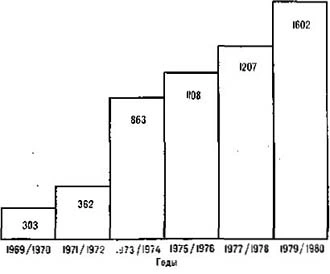
Table 1. Age of lifters first meeting the MS standard, 1973–1980
| Year | Age, years | Total | ||||||||
| 15–16 | 17–18 | 19–20 | 21–22 | 23–24 | 25–26 | 27–28 | 29–30 | over 31 | ||
| 1973 | — | 12 | 70 | 99 | 89 | 77 | 38 | 18 | 45 | 448 |
| 1974 | 1 | 15 | 76 | 87 | 69 | 66 | 38 | 20 | 43 | 415 |
| 1975 | — | 23 | 100 | 128 | 75 | 75 | 50 | 32 | 35 | 518 |
| 1976 | 2 | 41 | 145 | 132 | 114 | 63 | 40 | 24 | 29 | 590 |
| Total 1973–76 | 3 | 91 | 391 | 446 | 347 | 281 | 166 | 94 | 152 | 1971 |
| % | 0.2 | 4.6 | 19.8 | 22.6 | 17.6 | 14.3 | 8.4 | 4.8 | 7.7 | 100 |
| 1977 | 7 | 64 | 123 | 114 | 64* | 59 | 41 | 19 | 19 | 522 |
| 1978 | 7 | 81 | 158 | 149 | 124 | 71 | 43 | 27 | 25 | 685 |
| 1979 | 2 | 102 | 211 | 162 | 124 | 82 | 35 | 22 | 25 | 765 |
| 1980 | 13 | 135 | 236 | 179 | 115 | 73 | 41 | 24 | 21 | 837 |
| Total 1977–80 | 29 | 382 | 728 | 604 | 439 | 285 | 160 | 92 | 90 | 2809 |
| % | 1.0 | 13.6 | 25.9 | 21.5 | 15.6 | 10.2 | 5.7 | 3.3 | 3.2 | 100 |
* As printed; the 1977 row then sums to 510, not 522. The column total (439) implies 76.
- Age at first MS: 15–38; mean 23.5 years (1973–76) vs 22 (1977–80), p < 0.001; skewness 0.572 ± 0.055 and 0.767 ± 0.046, kurtosis not significant.
- Aged 22 or under: 47.2% → 62%. Numbers rose only at 15–24, more the younger: 15–16, 9.7×; 17–18, 4.2×; 19–20, 1.9×; 21–22, 1.4×; 23–24, 1.2×; unchanged at 25–30; down 1.7× over 31. Shares rose at 15–20 (17–18 +9%, 19–20 +6.1%).
Table 2. Bodyweight classes of lifters first meeting the MS standard, 1973–1980
| Year | Bodyweight class, kg | Total | |||||||||
| 52 | 56 | 60 | 67.5 | 75 | 82.5 | 90 | 100 | 110 | over 110 | ||
| 1973 | 29 | 12 | 30 | 43 | 100 | 108 | 66 | — | —* | 53* | 448 |
| 1974 | 36 | 7 | 36 | 47 | 82 | 84 | 64 | 100* | 53 | 6 | 415 |
| 1975 | 37 | 13 | 41 | 69 | 118 | 114 | 61 | 33 | 29 | 3 | 518 |
| 1976 | 32 | 16 | 58 | 95 | 140 | 133 | 75 | 27 | 13 | 1 | 590 |
| Total 1973–76 | 134 | 48 | 165 | 254 | 440 | 439 | 266 | 160* | 148 | 17 | 1971 |
| % | 6.8 | 2.4 | 8.4 | 12.9 | 22.3 | 22.3 | 13.5 | 3.0 | 7.5 | 0.9 | 100 |
| 1977 | 29 | 29 | 42 | 80 | 112 | 108 | 79 | 35 | 6 | 2 | 522 |
| 1978 | 29 | 21 | 57 | 101 | 158 | 125 | 116 | 60 | 12 | 6 | 685 |
| 1979 | 31 | 32 | 59 | 113 | 198 | 165 | 94 | 56 | 12 | 5 | 765 |
| 1980 | 34 | 36 | 86 | 135 | 193 | 166 | 111 | 50 | 15 | 11 | 837 |
| Total 1977–80 | 123 | 118 | 244 | 429 | 661 | 564 | 400 | 201 | 45 | 24 | 2809 |
| %** | 4.4 | 8.7 | 15.3 | 23.5 | 20.1 | 14.2 | 7.2 | 1.6 | 0.8 | 0.8 | 100 |
* Inconsistent as printed. 1974, 100 kg: class not yet in use, row sums to 515; with 0 the column total would be 60 (= the printed 3.0%). 1973: row sums to 441; column totals imply 53 at 110 kg and 7 over 110 kg. ** Row shifted one column left: 56 kg should be 4.2% (118/2809), over 110 kg 0.9%.
- The class distribution is close to the theoretical near-normal one (Starodubtsev, 1976), except for an excess at 52 kg in 1973–76, due to unequal norms: in 1981 comparable points the MS norms then were (52–over 110 kg, without 100 kg) 302, 321, 314, 311, 301, 292, 288, 287, 293.
- So 56 kg lifters cut weight to reach MS sooner; after repeated cuts many promising lifters stalled short of international level. In 1977–80 all norms were aligned with the 56 kg level and the distribution normalised.
New MSIC as a function of new MS
From Table 3: NMSIC = 0.089·NMS − 32.766 (error ± 8), useful for planning. Deviations stay within 8 except in 1978 — an anomaly reflecting the higher MSIC norm and other factors yet to be identified.
Table 3. Actual numbers of MSIC and MS, 1973–1980, and NMSIC from equation (1)
| Grade | 1973 | 1974 | 1975 | 1976 | 1977 | 1978 | 1979 | 1980 | Total |
| MS | 448 | 415 | 518 | 590 | 522 | 685 | 765 | 837 | 4780 |
| MSIC | 2 | 2 | 16 | 25 | 17 | 12 | 42 | 46 | 162 |
| NMSIC (predicted) | 7 | 4 | 13 | 20 | 14 | 28 | 35 | 41 | 162 |
Norms relative to the world's ten best
The mean of the year's ten best scores regardless of class (1981 points table) and the averaged norms were expressed in comparable points; smoothed values follow the trend, 1981–83 are forecasts.
Table 4. Mean of the ten best lifters and MSIC and MS norms, in comparable points
| Year | Mean of ten best, points | Classification norms, points | Ratios, % | |||
| actual | smoothed | MSIC | MS | (4) : (3) | (5) : (3) | |
| 1 | 2 | 3 | 4 | 5 | 6 | 7 |
| 1973 | 396.4 | 397.0 | 385.4 | 297.4 | 97.1 | 74.9 |
| 1974 | 404.3 | 402.0 | 385.4 | 297.4 | 95.9 | 74.0 |
| 1975 | 403.4 | 406.9 | 385.4 | 297.4 | 94.7 | 73.1 |
| 1976 | 421.0 | 411.9 | 385.4 | 297.4 | 93.6 | 72.2 |
| 1977 | 411.8 | 416.9 | 393.1 | 309.1 | 94.3 | 74.1 |
| 1978 | 415.4 | 421.9 | 393.1 | 311.6 | 93.4* | 73.9 |
| 1979 | 426.7 | 426.8 | 393.1 | 314.2 | 92.1 | 73.6 |
| 1980 | 436.2 | 431.8 | 393.1 | 314.2 | 91.0 | 72.8 |
| 1981 | — | 436.8 | 411.5 | 323.3 | 94.2 | 74.0 |
| 1982 | — | 441.7 | 411.5 | 323.3 | 93.2 | 74.0* |
| 1983 | — | 446.7 | 411.5 | 329.0 | 92.1 | 73.6 |
* As printed; recalculation from columns 3–5 gives 93.2 (1978) and 73.2 (1982).
- Optimal ratios of norms to top results are unknown (cf. M. R. Smirnov, Teoriya i Praktika Fizicheskoi Kultury, 1976, No. 9), so the ratios proven by Soviet success should be kept. Suggested 1983 MS totals (52–over 110 kg): 205; 225; 240; 267.5–270; 290–292.5; 310–312.5; 325–327.5; 340; 350–352.5; 365–367.5 kg.
Comparison with track and field
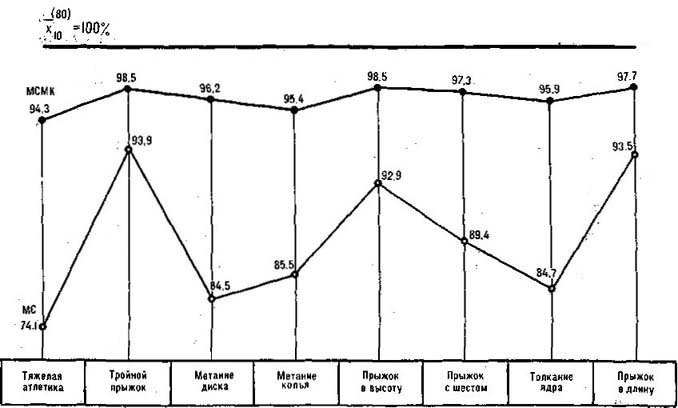
- In weightlifting the MSIC norm is 1.1–4.2% and the MS norm 10.4–19.8% easier than in these athletics events.
- Athletics norms are not equal in difficulty: the range is 3.1% for MSIC and 9.2% for MS. MS norms form two groups — jumps 89.4–93.9%, throws 84.7–85.5% (difference significant at 5%). In the jumps, MS norms average only 4.7% below MSIC norms.
Policy on MS norms and proposals
- One view says raise norms (a higher bar spurs training), the other lower them (more first-class lifters keep training, so more future Olympians) — after V. M. Zatsiorsky, E. Ya. Bondarevsky and A. N. Petrosyan (1975). Weightlifting's course — MS norms demanding yet attainable, as the growth in new MS shows — should continue.
- Weak spot: the 88-point MSIC–MS gap (vs 25 between MS and CMS) is a psychological barrier. Proposal: an intermediate standard of about 383 points — totals 230; 250; 270; 302.5; 327.5; 350; 365; 380; 392.5; 410 kg by class — for the immediate Olympic reserve.
- Junior grade III: e.g. 67.5 kg — clean-and-jerk 85% of bodyweight = 57.5 kg, snatch 57.5 × 0.775 (optimal ratio) = 45 kg, total 102.5 kg (90 points); other classes likewise. Junior classes up to 40 and 44 kg would also broaden participation.
- Keep norms up to CMS fixed in kilograms; set MS, intermediate and MSIC norms at 74–75%, 85–86% and 94–95% of the smoothed ten-best mean of the last year (or the forecast for the period), stimulating both participation and excellence.