Research methods
Filming the Weightlifter and Measuring the Kinematics of the Lift
English summary of Tyazhelaya Atletika. Ezhegodnik 1982 (Moscow: Fizkultura i Sport, 1982), pp. 60–64: the text is paraphrased, not translated; data tables are given in full with English labels; figures are the original images.
Background
- Earlier technique studies (N. I. Luchkin, L. N. Sokolov, R. A. Roman, M. S. Shakirzyanov, A. I. Falameev and others) remain valuable. Without electronic recording, though, they were imprecise and not systemic: they looked either at the bar path or at the joint angles.
- Here the lift is seen as a system of motor actions made of subsystems. Each is bounded by key body positions and has its own goal (task and parameter change) that serves the whole. Optimal joint angles and other parameters must be studied together. Pedagogical kinesiology allows this through precise filming of the body segments and the bar.
Equipment and data processing
- Developed at the Laboratory of Pedagogical Kinesiology, E. Vilde Tallinn Pedagogical Institute (head Kh. Kh. Gross): electronic speed stabilisation of the cine camera (25, 50, 100 frames/s) and electronic synchronisation of two or more cameras for multi-plane filming.
- A semi-automatic coordinate digitiser puts each frame onto punched tape as one array, numbered like the frame. Array 0 holds the state of the digitiser. Background points at a fixed, known spacing give the X axis and the scale; every frame has the same number of them.
- The computer program “Kinematic analysis” computes snatch and clean-and-jerk parameters (up to 200,000 values) and corrects for 45° filming.
- More than 7 times faster than before; error no more than 1–2%.
Objectives
- 1. Best camera position(s) for filming in normal training or competition.
- 2. A system of kinematic points on the joints, with algorithms for computing the parameters.
- 3. First analysis of the motion of the bar, the body segments and the joint angles.
Markers and computed quantities
Table 1. Kinematic points
| No. | Main set (snatch, clean) | No. | Additional points for the jerk |
| 1 | ear lobe | 1 | right knee joint |
| 2 | shoulder joint | 2 | right ankle joint |
| 3 | hip joint | 3 | right toe |
| 4 | knee joint | 4 | right heel |
| 5 | ankle joint | 5 | hand |
| 6 | left toe | ||
| 7 | left heel | ||
| 8 | elbow joint | ||
| 9 | bar |
Table 2. Computer definitions (algorithms); numbers refer to the main points in Table 1
| No. | Quantity | Points |
| 1 | angle | 1 2 3 |
| 2 | angle | 2 3 4 |
| 3 | angle | 5 4 3 |
| 4 | angle | 4 5 6 |
| 5 | angle | 2 8 9 |
| 6 | angle | 2 3 9 |
| 7 | tilt | 3 2 |
| 8 | tilt | 3 4 |
| 9 | tilt | 5 4 |
| 10 | y coordinate | 9 |
| 11 | y velocity | 9 |
| 12 | y acceleration | 9 |
| 13 | x coordinate | 9 |
| 14 | x velocity | 9 |
| 15 | x acceleration | 9 |
| 16 | y coordinate | 2 |
| 17 | y velocity | 2 |
| 18 | y acceleration | 2 |
| 19 | x coordinate | 2 |
| 20 | x velocity | 2 |
| 21 | x acceleration | 2 |
| 22 | y coordinate | 3 |
| 23 | x coordinate | 3 |
| 24 | x velocity | 3 |
| 25 | y coordinate | 6 |
| 26 | y coordinate | 7 |
Definition 1 is printed “12 3” (spacing damaged). The number of definitions depends on the research task; points are digitised in a fixed order.
Camera-position experiment
- 32 frames/s; lens 7 m from the lifter; 35 mm film; scale rod marked every 10 cm.
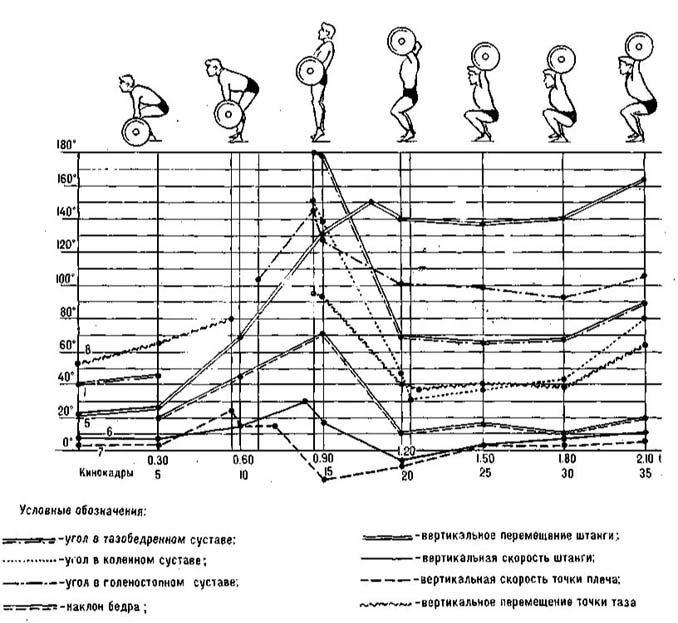
- Side view (Fig. 1): unsuitable, because the plates hide the body. Hip, knee and ankle angles, thigh tilt and the rise of the hip point cannot be followed.
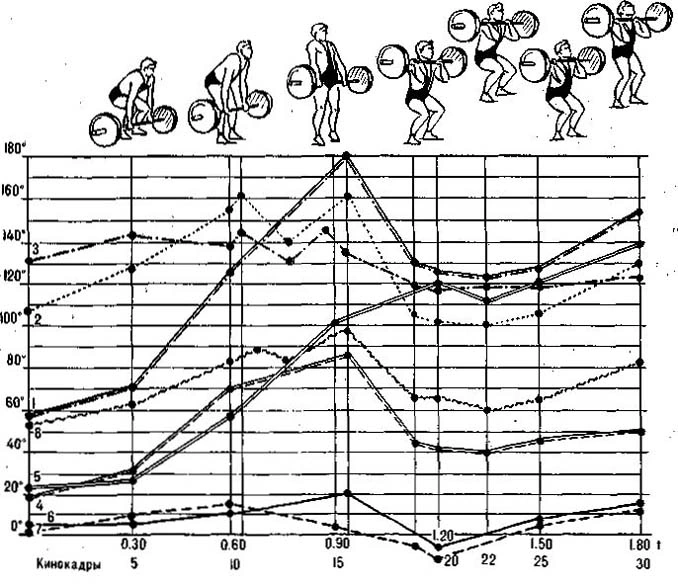
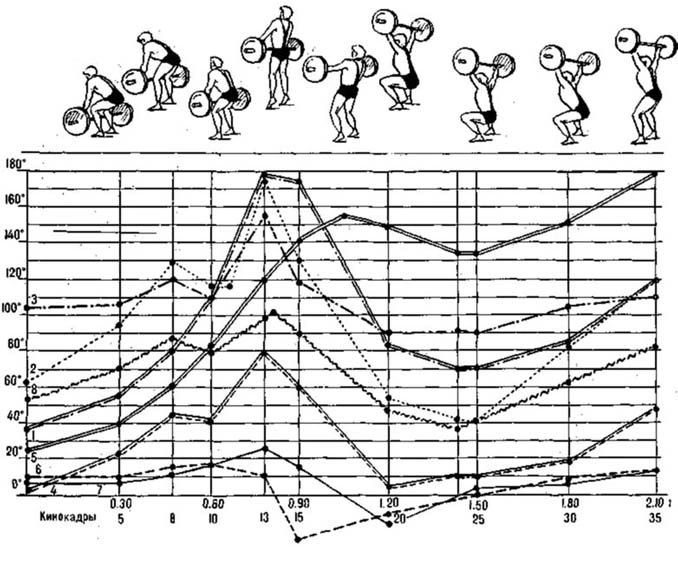
- 45° front-side and back-side views (Figs. 2, 3): fullest data on angles, displacements and velocities at any moment.
First results
- Clean with half squat, front-side (Fig. 2; curves 1–8 in the order of the Fig. 1 legend): hip and knee angles, hip-point rise and shoulder velocity dip after frame 10, then peak at frame 15 (all joints extended), then almost all fall. Only the bar keeps rising, until frame 20.
- Snatch, back-side (Fig. 3): hip and knee angles and thigh tilt start to decrease earlier than in the clean (frame 8). Almost all angles then rise until frame 20 and fall again.
- World record holders were not filmed, and there are no general data on elite lifters yet. Next step: optimal models of the snatch, clean and jerk.
Conclusions
- Use a speed-stabilised camera, and electronically synchronised cameras for two or more planes.
- Film from front-side or back-side. For two planes, place one camera front-side and one back-side, each at 45°.
- Precise filming plus computer measurement makes optimal models of snatch and clean-and-jerk technique possible.