Research methods
An Improved Recorder of the Bar’s Vertical Displacement, Velocity and Acceleration
English summary of Tyazhelaya Atletika. Ezhegodnik 1982 (Moscow: Fizkultura i Sport, 1982), pp. 66–68: the text is paraphrased, not translated; figures are the original images.
Purpose
- Model: the V. A. Klynin and S. I. Lelikov instrument (1972), the best so far, but transistor-based, heavy and bulky.
- Goal: same principle, compact electronics (by V. A. Klynin), simple reliable mechanics. No mechanical part precise enough for electronic differentiation, especially of acceleration, had existed before.
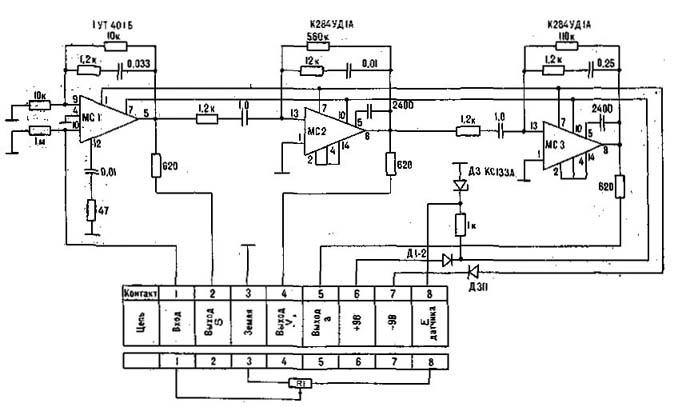
Electronics (Fig. 1)
- Multi-turn potentiometer R1 (PPML-M, 10 kΩ), stabilised supply via contacts 3 and 8. Its output voltage, proportional to turns, i.e. bar travel, enters at contact 1.
- MS1 (1UT401B IC), power amplifier: displacement at contact 2.
- MS2, MS3 (K284UD1 series), differentiating amplifiers: velocity (dx/dt) at contact 4, acceleration at contact 5.
- Power via contacts 6 and 7. Ground is the centre point (contact 3), the reference for all outputs.
- Board 160 × 70 mm. Any supply with a centre tap and low ripple. Everything except R1 fits a 245 × 110 × 110 mm metal box.
Mechanics (Fig. 2)
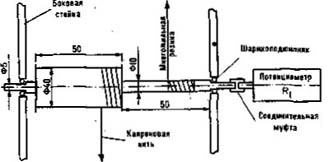
- Shaft: a 40 mm drum plus a 10 mm section for the return mechanism (multi-strand rubber and an elastic metal plate).
- A nylon thread runs from the drum over a pulley to the bar.
- Plastic-sleeve coupling to the potentiometer slider. It must be exactly coaxial, so mount the potentiometer carefully on the side wall.
- Records up to 2.5 m of bar height (from the bar centre).
- A light plastic shaft gives low inertia and a reliable return. Load on the bar up to 100 g.
Use
- Tested repeatedly on elite lifters, including USSR team members.
- Accurate acceleration gives the force on the bar, which is useful compared with platform forces.
The acceleration is printed as “d²x/dt”.