Research methods
Measuring the Forces a Weightlifter Applies to the Bar and to the Platform
English summary of Tyazhelaya Atletika. Ezhegodnik 1982 (Moscow: Fizkultura i Sport, 1982), pp. 64–66: the text is paraphrased, not translated; figures are the original images.
Problem
- Force platforms (Luchkin 1962; Arutyunyan 1964; Bykov 1966; Sokolov 1967) register bar forces only after they pass through the body. The signal has many components, several variable, so the true force on the bar is hard to isolate (Zhekov 1976). Nothing is recorded in the drop under the bar, when the feet leave the floor.
- Accelerometers on the bar end or plates: distorted by bar bending, need extra calculation, sensitive to drops.
Strain-gauge bar
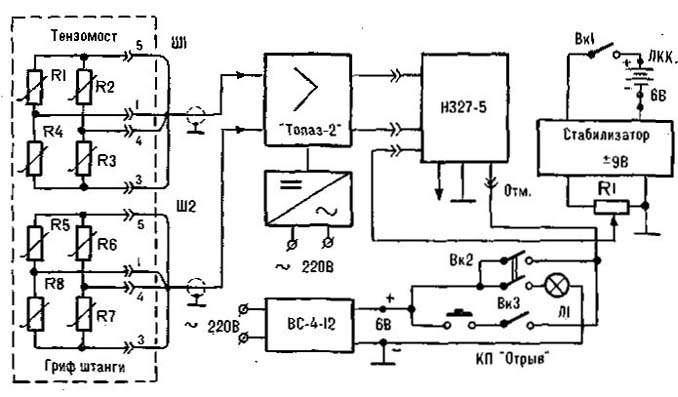
- Four flats milled on the middle of the bar carry eight 2FKPA gauges (15 mm base, 106 Ω) in two bridges, vertical and horizontal. Made with G. P. Shupushkin and I. G. Baranov.
- Bridge → TOPAZ-2 amplifier → N-327-5 chart recorder. The trace follows bar deflection, which is proportional to force.
- Range 0–500 kg per component; error ±2% of full scale.
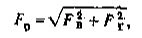
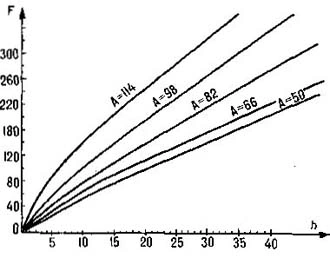
- Forces are read from a calibration chart that allows for grip width (Fig. 3).
- Bar strain gauging was known (B. V. Minenkov, 1967) but little used: the bar must be oriented at the start, and deflection depends on grip width.
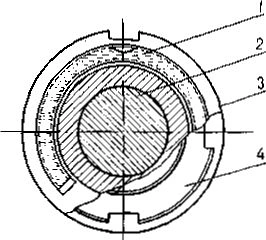
- Level: a sleeve on the bar holds a sealed alcohol-filled PVC tube. The bubble shows the orientation at lift-off. Drop-proof and does not hinder the lifter.
Application
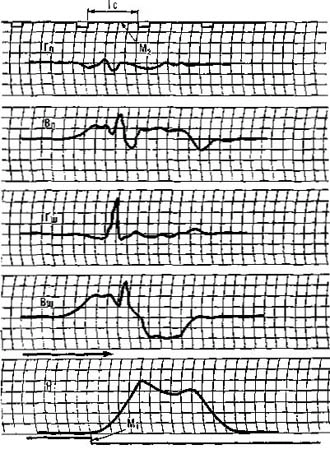
- Snatch: bar forces differ clearly from platform forces (Fig. 4). The least-studied moments are of most interest: the II/III phase boundary and the unsupported phase.
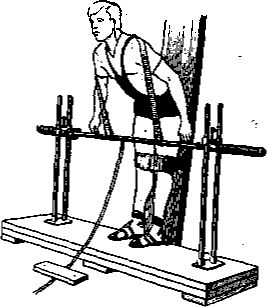
- Isometric: a rig (Fig. 5) uses the bar to measure resultant forces of muscle groups (leg and trunk extensors) and in lifting positions (start, second pull). Same deflection principle.
- The bar as its own sensor proved informative and practical for training.